
Attracting traffic is just the entry ticket. The real commercial win lies in converting that traffic into bookings, clients, or qualified leads. Your website’s ability to guide a user from interest to action—be it booking a tour, starting a trial, or making an enquiry—is a direct measure of its commercial effectiveness. This is the essence of Conversion Rate Optimisation (CRO).
CRO is not about guesswork or chasing design trends. It is a systematic process of understanding user behaviour, identifying friction in their journey, and making data-driven improvements that directly impact your bottom line. For tourism operators, this means more direct bookings and less commission paid to third parties. For SaaS businesses, it means a higher trial-to-paid conversion rate. For professional service firms, it translates to more high-quality, sales-ready leads.
Too many businesses invest heavily in driving traffic only to see potential revenue evaporate due to a confusing, frustrating, or untrustworthy user experience (UX). Effective CRO transforms your website from a digital brochure into your most productive sales engine. This article cuts through the generic advice to deliver ten high-impact conversion rate optimization strategies, each grounded in UX best practice and designed to help you stop guessing and start achieving measurable growth.
1. Conduct a Heuristic UX Audit to Find Friction Fast
A heuristic UX audit is an expert evaluation of your website against established usability principles. Unlike automated tools that only flag technical errors, this audit uses human judgment to uncover the conversion barriers that frustrate users and directly harm your revenue. It is one of the most cost-effective conversion rate optimisation strategies for diagnosing why users aren't converting.

This method is particularly powerful for booking websites, SaaS platforms, and professional service firms. For instance, a tourism operator might discover a confusing date-picker causes 40% of users to abandon their booking. A SaaS company might find an ambiguous call-to-action on its pricing page is suppressing trial sign-ups. These are not minor flaws; they are direct revenue leaks.
Why It Works for Commercial Outcomes
A heuristic audit delivers a prioritised roadmap for improvement without the time and cost of large-scale user testing. It's the ideal starting point for any CRO programme, especially when analytics show a problem (e.g., high bounce rate) but don't explain the cause. The expert review contextualises quantitative data with qualitative insights, explaining the "why" behind user drop-offs.
Key Insight: A heuristic audit rapidly identifies the "low-hanging fruit"—high-impact, low-effort fixes that can deliver an immediate lift in bookings or leads. It focuses your team on proven usability principles, eliminating guesswork.
How to Apply This Strategy
Map Critical User Journeys: Focus the audit on your most important conversion funnels, such as the booking process, trial sign-up flow, or lead form submission.
Prioritise by Commercial Impact: Organise recommendations based on their potential conversion lift and implementation effort. This ensures your team tackles the most valuable fixes first.
Benchmark Against Competitors: Contextualise findings by seeing how your user experience stacks up against key competitors. Learn more about competitor UX analysis on GetConversionUX.com.
Validate with Analytics: Use data from tools like Google Analytics or heatmaps to validate the audit’s findings and quantify the scale of each problem identified.
2. Use A/B Testing to Validate Changes with Data
A/B testing (or split testing) is a controlled experiment comparing two or more versions of a webpage to see which one drives more conversions. It is a foundational conversion rate optimisation strategy that removes internal debates and assumptions from website improvements, allowing you to make confident, revenue-focused decisions based on real user behaviour.
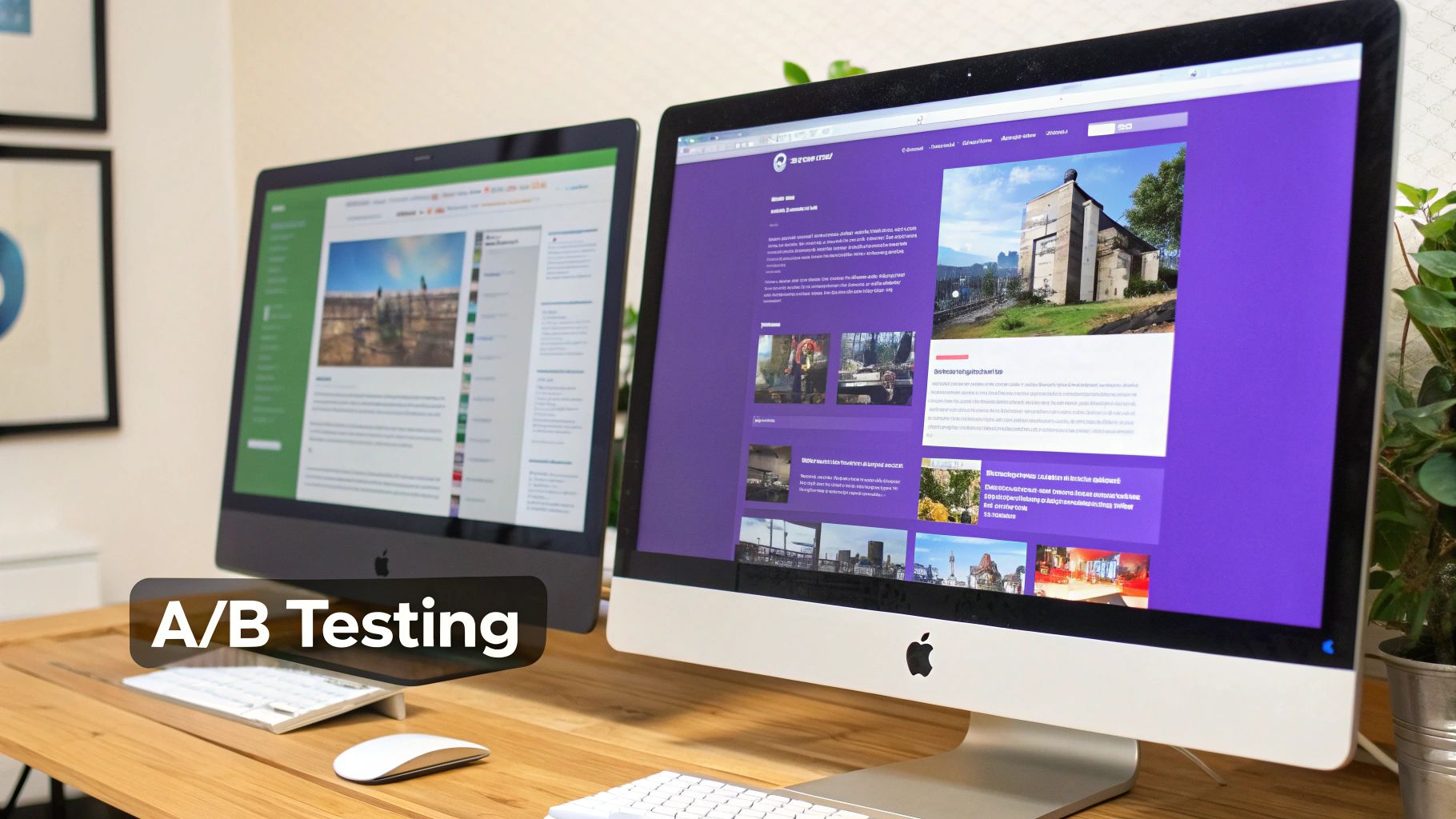
This method is crucial where small changes can have a significant commercial impact. A travel booking site could test a simplified one-page checkout against a multi-step form to see which reduces cart abandonment. A SaaS platform might test a "Start Free Trial" call-to-action against "Request a Demo" to discover which generates more qualified leads—a test that can yield a 10-20% uplift in sign-ups.
Why It Works for Commercial Outcomes
A/B testing provides definitive, quantitative proof of what works best for your specific audience. Instead of debating design or copy choices internally, you let your users' actions declare the winner. It is the ideal method to validate hypotheses generated from a UX audit or analytics data. Once you have identified a potential conversion barrier, A/B testing is the most reliable way to prove that a proposed solution actually improves performance.
Key Insight: A/B testing is about more than finding a winner; it's about learning what motivates your audience. Each test, win or lose, provides valuable insights into user behaviour that can inform your entire marketing and product strategy.
How to Apply This Strategy
Formulate a Clear Hypothesis: Start with a specific, measurable hypothesis. For example: "Changing the CTA button text from 'Submit' to 'Get My Free Quote' will increase form submissions by 15% because it highlights value."
Test One Variable at a Time: To get clean data, isolate a single element per test (e.g., just the headline or just the image). This ensures you know exactly what caused the change in performance.
Ensure Statistical Significance: Use a testing tool to calculate the required sample size and run the test long enough to achieve statistical confidence (typically 95% or higher). Do not end tests prematurely based on early trends.
Document and Learn: Maintain a log of all hypotheses, results, and key learnings. This creates an institutional memory that prevents re-testing old ideas and accelerates future optimisation efforts.
3. Conduct Real User Testing to Uncover the "Why"
Real user testing involves observing actual users as they interact with your website, often while they "think aloud." By watching and listening, you uncover the human frustrations and decision-making processes that quantitative analytics alone cannot explain. This is one of the most powerful conversion rate optimisation strategies for revealing the "why" behind drop-offs.
This qualitative method is invaluable for understanding complex user journeys. A professional services firm might discover potential clients abandon an enquiry form because they perceive the questions as too invasive. A SaaS company could watch trial users repeatedly fail to find a key feature, leading to churn. Watching just a handful of users can expose critical flaws in your assumptions about how your website actually works.
Why It Works for Commercial Outcomes
While analytics tell you what users are doing (e.g., 50% drop-off on the pricing page), user testing tells you why. This insight is essential for developing effective solutions rather than just guessing. It's best used when analytics data points to a problem but doesn't provide a clear cause, or to test a new design before committing development resources.
Key Insight: User testing closes the gap between your assumptions and your users' reality. Observing even five people from your target audience can uncover major usability issues that your internal team, who know the site inside-out, would never spot.
How to Apply This Strategy
Recruit Your Target Audience: Test with people who represent your actual customers. Using the wrong participants will yield misleading results and poor business decisions.
Assign Goal-Oriented Tasks: Give users specific tasks, such as "Book a half-day tour for two adults" or "Sign up for a free trial and create your first project." This simulates real-world usage.
Ask Open-Ended Questions: Avoid leading questions. Instead of "Was that easy?", ask "What are your thoughts on that step?" to encourage unfiltered feedback.
Look for Non-Verbal Cues: Pay attention to hesitation, sighs, or erratic cursor movements. These are often clear signs of confusion or frustration. Learn how to find and fix these real conversion killers on GetConversionUX.com.
4. Streamline Forms to Reduce Abandonment
Form optimisation is the process of simplifying online forms to reduce user friction and increase completion rates. Forms are the final gateway to conversion for bookings, sign-ups, and enquiries, but they are also a primary source of user abandonment. Every additional field or confusing label adds cognitive load, making this one of the most critical conversion rate optimisation strategies.
This strategy is paramount for service-based businesses and SaaS. A travel operator could see a 30% uplift in completed bookings by reducing a 15-field form to 7 essential fields. A SaaS platform can significantly increase trial sign-ups by removing the credit card field or implementing progressive profiling, asking for information in small chunks over time rather than all at once.
Why It Works for Commercial Outcomes
The principle is simple: the easier you make it for users to complete a task, the more likely they are to do it. By removing unnecessary steps and clarifying the process, you directly lower the barrier to conversion. This should be a top priority whenever your analytics show a high drop-off rate at a form stage, whether it's a booking funnel, lead generation form, or SaaS sign-up process.
Key Insight: A form is a conversation, not an interrogation. Each field you remove is a question you've chosen not to ask, making the user's journey faster and more respectful of their time. This builds trust and directly boosts your conversion rate.
How to Apply This Strategy
Audit and Justify Every Field: For each field, ask: "Is this information absolutely essential to complete this transaction right now?" If not, remove it.
Improve Field Usability: Use dropdown selectors for predefined options, ensure numeric keyboards appear for phone number fields on mobile, and implement autofill to speed up data entry.
Show Clear Progression: For multi-step forms, use a visible progress indicator to manage user expectations and reduce the likelihood of abandonment. This is highly effective for complex booking flows.
Use Conditional Logic: Make forms "smarter" by only showing relevant fields based on previous answers. For example, only display "Company Size" if a user identifies as a business lead.
5. Use Heatmaps & Session Recordings to See What Users See
Heatmaps and session recordings are powerful conversion rate optimisation strategies that show you how individual users interact with your website. Heatmaps visualise where users click, scroll, and move their cursors, while session recordings provide video-like playbacks of real user journeys. Together, these tools reveal user attention and frustration patterns that aggregate data cannot.
These behavioural analytics tools offer undeniable proof of UX issues. A tourism operator might use a scroll map to discover that users are not seeing a crucial 'Book Now' button because it's below the fold on mobile devices. A professional services firm could find through click maps that 60% of visitors are clicking on a non-interactive image, expecting a link—a clear signal of a missed opportunity.
Why It Works for Commercial Outcomes
Heatmaps and session replays provide the critical "why" behind your analytics. If you see a high drop-off rate on a booking form, session recordings can show you the exact field where users struggle. This approach is invaluable for validating design hypotheses, identifying bugs, and understanding user intent before investing in development or A/B testing.
Key Insight: These tools expose the gap between how you think users navigate your site and how they actually do. Watching real user sessions builds empathy and provides undeniable evidence to get team buy-in for necessary UX changes.
How to Apply This Strategy
Segment Your Data: Don't watch random sessions. Filter recordings for users who abandoned the checkout, users from a specific marketing campaign, or users on mobile devices to find relevant patterns.
Compare Converters vs. Non-Converters: Analyse heatmaps for users who completed a booking versus those who didn't. This often reveals key differences in engagement and shows what successful users interact with.
Focus on High-Impact Pages: Start by analysing your homepage, pricing pages, and key landing pages. Look for "rage clicks" (repeated, frantic clicking) and "U-turns" (quick page exits) as clear signs of user frustration.
Identify Patterns, Not Outliers: Base your decisions on recurring behaviours observed across multiple sessions. A single user's strange behaviour is an anomaly; ten users doing it indicates a design flaw.
6. Adopt a Mobile-First Approach for the Modern User
Mobile-first optimisation is a design strategy that prioritises the mobile user experience from the start. Instead of creating a complex desktop website and then shrinking it for smaller screens, this approach forces you to focus on the most critical content and functionality first, ensuring a lean, fast, and intuitive experience for the majority of modern users.
With over 60% of web traffic now coming from mobile devices, this is non-negotiable for conversion rate optimisation strategies. For a travel operator, a clunky mobile booking form is a major conversion killer. For a SaaS company, discovering that 40% of free trial sign-ups are initiated on a phone makes mobile form usability a top priority.
Why It Works for Commercial Outcomes
A mobile-first approach leads to a cleaner, more focused user experience for everyone. By designing for constraints, you eliminate clutter and ensure core user journeys are as frictionless as possible. It is essential for any business where users are likely to be on-the-go or researching from their phones, such as booking tours or scheduling appointments.
Key Insight: Designing for mobile first forces discipline. It compels you to strip away non-essential elements and focus entirely on the core conversion path, resulting in a faster, more intuitive experience that benefits both mobile and desktop users.
How to Apply This Strategy
Prioritise Core Actions: Identify the single most important action on each page (e.g., "Book Now") and make it a prominent, sticky element in the mobile viewport.
Enlarge Tap Targets: Ensure all buttons, links, and form fields have a minimum tap target size of 44x44 pixels to prevent frustrating mis-taps on smaller screens.
Embrace Mobile-Native Features: Integrate one-click payment options like Apple Pay and Google Pay, and use autofill for forms to drastically reduce user effort and abandonment.
Test on Real Devices: Do not rely solely on browser emulators. Test your critical conversion funnels on a range of actual iOS and Android devices to uncover real-world usability issues.
7. Optimise Trust Signals to Reduce User Anxiety
Trust signal optimisation is the strategic placement of elements that build credibility and reduce a user's perceived risk. For any website asking for personal data or payment, trust is the currency of conversion. These signals include testimonials, security badges, industry certifications, and social proof—all working to reassure users they are making a safe choice.
This strategy is paramount for booking websites and service firms where users must feel confident sharing sensitive information. A tourism operator showcasing recent, positive Tripadvisor reviews directly on a booking page can alleviate last-minute hesitation. A SaaS platform displaying logos of well-known clients like ‘Trusted by Xero and Spark’ reassures potential customers about the product’s legitimacy.
Why It Works for Commercial Outcomes
Trust signals directly address a user's primary psychological barrier to conversion: fear. By proactively answering questions like "Is this site secure?" or "Is this a reputable company?", you remove friction at critical decision-making moments. This is one of the most effective conversion rate optimisation strategies to implement just before a user is asked to commit, such as on a pricing or checkout page.
Key Insight: The impact of a trust signal is magnified when placed next to a point of friction. A security badge is most powerful on a payment form, and a strong testimonial is most persuasive next to a "Book Now" button.
How to Apply This Strategy
Be Specific and Quantifiable: Instead of saying "most customers are happy," use concrete data like "98% satisfaction rate from 1,200+ reviews." Numbers add significant credibility.
Use Authentic Visuals: Accompany testimonials with real customer photos. This simple addition can increase authenticity and make the praise feel more genuine.
Place Strategically at Friction Points: Add payment security logos (e.g., Stripe, Visa) directly within the checkout form. Position key client logos or industry awards near your primary call-to-action.
Leverage Video Testimonials: A short video of a satisfied client explaining the benefits they received is far more compelling and memorable than static text, providing powerful social proof.
8. Analyse Funnels to Pinpoint Revenue Leaks
Funnel analysis is the process of mapping user journeys through critical conversion paths, such as a booking process or trial sign-up. By visualising each step, you can precisely identify where users are abandoning the process. This quantitative approach isolates the highest-impact friction points, allowing you to prioritise optimisation efforts that address the biggest barriers to conversion.
This technique is fundamental for any business with a multi-step conversion goal. A travel operator might discover that 40% of users drop off at the date selection step because there's no clear indication of available dates. A SaaS company could find 25% of potential trial users abandon the process when asked for credit card details upfront. A professional services firm might see a 60% drop-off on a form that asks for budget information too early.
Why It Works for Commercial Outcomes
Funnel analysis moves you from guesswork to data-driven diagnosis. Instead of optimising random pages, you focus your resources on the exact steps causing the most significant revenue loss. This method is essential when your overall conversion rate is low but you're unsure which specific part of the user journey is broken. It provides a clear starting point for deeper investigation with heatmaps or user testing.
Key Insight: Funnel analysis pinpoints the costliest leaks in your conversion pipeline. By focusing on the single step with the highest abandonment rate, you can make targeted improvements that deliver the most substantial lift to your overall conversion numbers.
How to Apply This Strategy
Set Up Funnels in Analytics: Use a tool like Google Analytics 4 to define the exact steps in your critical user journeys. This is a foundational step for any serious conversion rate optimisation strategy.
Segment by Device: Analyse your funnels separately for desktop and mobile users. Mobile abandonment rates are often higher at different steps due to unique usability challenges.
Identify the Biggest Drop-off: Pinpoint the step with the highest absolute number of user drop-offs. This is your primary target for optimisation.
Combine with Qualitative Data: Once you know where users are leaving, use heatmaps or session recordings to understand why. Are they rage-clicking a broken button or confused by a form field? Our booking flow blueprint offers more practical advice.
9. Optimise Copy and Messaging for Clarity and Action
Copy and messaging optimisation involves refining headlines, button text, and value propositions to clearly communicate benefits and guide users toward action. Your words are a powerful conversion tool; they can either build confidence or create confusion. Strong messaging directly addresses user motivations and anxieties, making the decision to convert feel both logical and easy.
This is a critical strategy for any business where clarity is paramount. A tour operator can increase bookings by changing a generic "Submit" button to "Book My Adventure Now". A SaaS company can reduce sign-up hesitation by adding "No credit card required" next to their trial button. A professional services firm might see a 25% lift in enquiries by testing "Schedule Free Consultation" against a vague "Contact Us".
Why It Works for Commercial Outcomes
Effective copy bridges the gap between what your service offers and what your customer truly wants. It articulates your value proposition in the customer's language, answering their unspoken questions and overcoming objections before they arise. This is one of the most impactful conversion rate optimisation strategies because it directly influences a user's motivation at critical decision points.
Key Insight: People don't buy features; they buy better versions of themselves. Optimised copy focuses on the transformation or outcome your service provides. It shifts the focus from "what it is" to "what it does for you".
How to Apply This Strategy
Test Benefit-Oriented Headlines: Instead of describing your service, lead with the primary benefit the user will receive. Frame it from their perspective.
Use Action-Oriented Button Copy: Your call-to-action (CTA) buttons should clearly state what will happen next. Use verbs that imply value, such as "Get My Free Quote" or "Start My 14-Day Trial".
Address Objections Proactively: Identify common user concerns (e.g., pricing, commitment) and address them directly in your copy. For booking sites, mentioning "Instant Confirmation" or "Free Cancellation" can significantly reduce friction.
Speak Directly to the User: Use the second person ("you" and "your") to create a direct, personal connection with the reader, making the message more engaging and persuasive.
10. Implement Robust Analytics and Tracking
Robust analytics and tracking is the foundation of any successful CRO programme. It involves systematically setting up tools to capture user behaviour, conversion events, and revenue attribution. Without accurate data, all other conversion rate optimisation strategies are based on guesswork, lacking the insights needed for confident, high-impact decisions.
This foundational step ensures you can measure what matters. A travel operator can track not just the final booking but which marketing channel delivered the highest-value customers. A SaaS company can measure trial sign-up rates, feature adoption, and the precise drop-off points in the journey from trial to paid subscription. A professional services firm can monitor lead form submissions and attribute them back to specific campaigns.
Why It Works for Commercial Outcomes
Proper tracking turns your website into a measurable ecosystem, providing the quantitative data needed to identify problems, validate hypotheses, and prove the ROI of your optimisation efforts. It is the essential first step before embarking on A/B testing or making significant UX changes. It provides the "what" and "how many" that qualitative methods like user testing explain the "why" for.
Key Insight: Flawless analytics implementation is non-negotiable. It’s the difference between making strategic, data-driven improvements and blindly changing elements hoping for a positive outcome. Reliable data is the bedrock of sustainable growth.
How to Apply This Strategy
Configure Key Conversion Events: Ensure tools like Google Analytics 4 are properly set up to track your primary business goals. This includes events like ‘booking_complete’, ‘trial_signup’, or ‘lead_form_submission’.
Track Funnel Milestones: Don’t just track the final conversion. Map and monitor intermediate steps like ‘add_to_cart’ or ‘view_pricing_page’ to identify specific drop-off points.
Implement Revenue Tracking: Where applicable, pass revenue data into your analytics. This allows you to connect optimisation efforts directly to bottom-line impact and calculate ROI.
Document Everything: Create a measurement plan that outlines every custom event you track, what it means for the business, and how it is triggered. This ensures consistency and clarity for your entire team.
CRO Strategies: 10-Point Comparison
Turn These Strategies into Revenue
You now have a toolkit of powerful conversion rate optimisation strategies. We’ve moved beyond generic advice, diving into the diagnostic and psychological levers that transform visitors into customers. From the foundational clarity of a heuristic UX audit to the definitive proof of A/B testing, the path to higher conversions is clear: it’s a systematic, user-centric process, not a guessing game.
The journey begins with understanding why users are dropping off, not just where. A clunky mobile booking form isn’t just an inconvenience; it’s a direct revenue leak. An unclear value proposition on a SaaS pricing page isn’t just bad copy; it’s a barrier to growth. Each strategy we’ve explored is a piece of a larger puzzle. When assembled correctly, they create a seamless, persuasive digital experience that serves both your user and your bottom line.
Your Roadmap to Higher Conversions
To capitalise on this knowledge, you must move from reading to doing. The difference between a struggling website and a high-performing one lies in consistent, data-driven action.
Prioritise Your Diagnostics: You cannot fix what you don’t understand. If you have traffic but low conversions, a heuristic audit or real user testing will deliver the most impactful insights quickly. If you have plenty of data, a deep dive into your funnel analysis is your starting point.
Focus on the Biggest Leaks First: Where is the most significant drop-off in your user journey? Is it the checkout page? The trial sign-up form? Use analytics and heatmaps to identify this critical friction point and focus your initial efforts there. Fixing the biggest hole in the bucket always yields the fastest results.
Commit to a Testing Cadence: True conversion rate optimisation is not a one-off project but an ongoing business process. Commit to running at least one A/B test per month or conducting a round of user testing every quarter to create a continuous feedback loop.
Key Takeaway: The most successful conversion rate optimisation strategies are not isolated tactics but part of an integrated system of listening, testing, and iterating. It's a cultural shift towards making every decision with the user and the data in mind, transforming your website from a static brochure into a dynamic, revenue-generating engine.
Uncover Your Hidden Conversion Gaps, Fast
Implementing these conversion rate optimisation strategies requires a systematic, expert-led approach. While the insights here provide a powerful starting point, the fastest way to uncover your site's specific conversion gaps is with a targeted analysis.
Our free UX Snapshot service is designed for busy leaders who need to identify high-impact opportunities without a lengthy commitment. In just a short time, we'll analyse your critical user journeys and provide a concise, actionable report on where you're losing customers and exactly how to fix it. Stop leaving money on the table and discover your biggest conversion wins, fast.

Subscribe to our newsletter
Stop losing bookings, get insider tips to turn your website into a conversion machine.
More posts
Insights to help you turn more visitors into bookings, through better SEO, UX, and conversion strategy.
Customer journey mapping for bookings and enquiries (practical guide)

Marketing for B2B: A Modern Playbook for High-Growth
How Strategy and Branding Drives Conversions for NZ Businesses