
An effective growth and strategy plan doesn't start with a bigger ad budget. It starts by finding and fixing the hidden conversion leaks already costing you bookings, leads, and sales. Too many businesses pour cash into acquiring new traffic, only to have qualified customers abandon their website over easily fixable user experience (UX) issues.
Real, sustainable growth comes from plugging those leaks to maximise the value of every visitor you already have.
Your Growth Strategy Is Leaking Money

Many leaders treat marketing spend like a tap, thinking that cranking it open will automatically fill the sales pipeline. This "more traffic" mindset misses the most critical question: what if your website is a leaky bucket? Every pound spent on Google Ads or social media is wasted if users land on a site that frustrates, confuses, or blocks them from taking action.
These "leaks" are tangible points of friction in the user journey that cause good-fit customers to leave, directly draining your revenue.
For a tourism operator, a leak could be a clunky booking calendar that breaks on mobile, costing direct bookings. For a SaaS company, it might be a vague pricing page that fails to convert trial users into paying customers. For a professional service business, it's often a long, complicated contact form that deters high-value prospects.
The Real Commercial Cost of a Poor User Experience
Ignoring these conversion leaks has serious, measurable consequences. A flawed growth strategy focused only on acquisition leads directly to:
Wasted Ad Spend: You're paying to attract visitors who never convert. Analytics will show you the drop-off, but it's UX and CRO that explain why.
Lower Lead Quality: Confusing forms or unclear service descriptions attract unqualified leads, wasting your sales team's time and resources.
Reduced Bookings: A difficult checkout process is the number one reason for abandoned carts and lost accommodation or tour bookings.
High Churn Rates: For SaaS businesses, if the trial experience doesn't immediately deliver on the marketing promise, users won't see the value and will never upgrade to a paid plan.
A sustainable growth strategy is built on a foundation of conversion optimisation. Instead of just chasing more traffic, the goal is to convert more of the visitors you already have into valuable customers.
To get a clearer picture of where your strategy is leaking money, mastering cohort retention analysis can show you exactly when and why users are dropping off over time. This diagnostic work is at the heart of effective user experience optimisation.
It's about turning your website from a leaky bucket into a high-performance conversion engine. The shift is simple but powerful: stop paying for wasted clicks and start investing in an experience that turns visitors into revenue.
Uncover Your Hidden Conversion Gaps Fast
Stop guessing where your website is losing money. Our UX Snapshot is a fast, expert-led analysis that identifies the most critical conversion leaks in your funnel. Get the actionable insights you need to improve your growth strategy today.
Why Fixing Your Funnel Is The Ultimate Growth Play
There’s a common trap in growth and strategy: the relentless chase for more traffic. Business leaders pump money into ads, thinking more visitors will magically lead to more revenue. But this approach is not just expensive; it delivers diminishing returns.
Real, sustainable growth doesn’t come from pouring more water into a leaky bucket. It comes from fixing the leaks first.
Focusing on conversion rate optimisation (CRO) is where the smart money is. Every improvement you make to your website is a permanent asset that delivers compounding value. Doubling your conversion rate has the same impact on your bottom line as doubling your entire marketing budget. The difference? CRO creates a lasting improvement; a bigger ad budget is a temporary fix.
The Compounding Power of Small UX Wins
You don't need a massive, expensive website overhaul to see a big difference. Often, it's the small, strategic UX improvements that dramatically lift conversions without you touching your marketing spend. These "quick wins" build momentum and prove the commercial value of putting users first.
Consider these practical examples:
Tourism Operators: A confusing booking calendar with unclear availability is a classic conversion killer. Simplifying the date selection and making mobile checkout seamless can cause an immediate jump in direct bookings, reducing reliance on costly third-party booking sites.
SaaS Companies: Vague pricing tiers are a major reason users abandon the trial-to-paid journey. Clarifying the features and value of each plan helps users confidently choose the right option, directly boosting monthly recurring revenue (MRR).
Professional Services: A contact form that asks for too much information upfront is a huge barrier for high-quality prospects. Cutting it down to the essentials—name, email, message—can significantly increase the number of qualified leads generated.
Each of these changes plugs a specific "leak" in the customer journey, turning abandoned sessions into revenue.
Your website is your most important salesperson. It works 24/7. When you optimise its performance, you're not just making small tweaks; you're fundamentally improving its ability to generate revenue from the traffic you already have.
Shifting from Acquisition Cost to Lifetime Value
A growth strategy built on conversion optimisation naturally shifts your focus from just acquiring a customer to maximising their lifetime value. A smooth, intuitive user experience doesn't just win the first sale—it builds the trust and satisfaction that create customer loyalty and repeat business.
This is where digging into user behaviour becomes critical. Tools like heatmaps can show you exactly where people are clicking—or, more importantly, where they aren't. Session recordings let you watch real user journeys unfold, revealing points of confusion that raw analytics data can't explain.
To truly unlock this growth play, you need to understand how to effectively optimize your sales funnel. This isn't about guesswork; it's about a data-led process of continuous improvement. By finding and fixing these friction points, you create a smoother path to purchase that directly impacts your bottom line.
The undeniable ROI comes from this simple truth: the fastest and most efficient path to growth is already on your website, waiting to be unlocked.
Uncover Your Hidden Conversion Gaps Fast
Stop guessing where your website is losing money. Our UX Snapshot is a fast, expert-led analysis that identifies the most critical conversion leaks in your funnel. Get the actionable insights you need to improve your growth strategy today.
How To Find Your Website's Hidden Conversion Blockers
Finding the hidden friction points on your website is the first practical step in building a growth strategy that actually works. It's not about guessing what might be wrong; it's about a systematic diagnosis of where and why people are leaving. This isn’t technical wizardry. It’s about using the right tools to listen to what your users’ behaviour is telling you.
The process is simple: identify where traffic drops off, find the leaks causing it, and fix them to improve conversion.
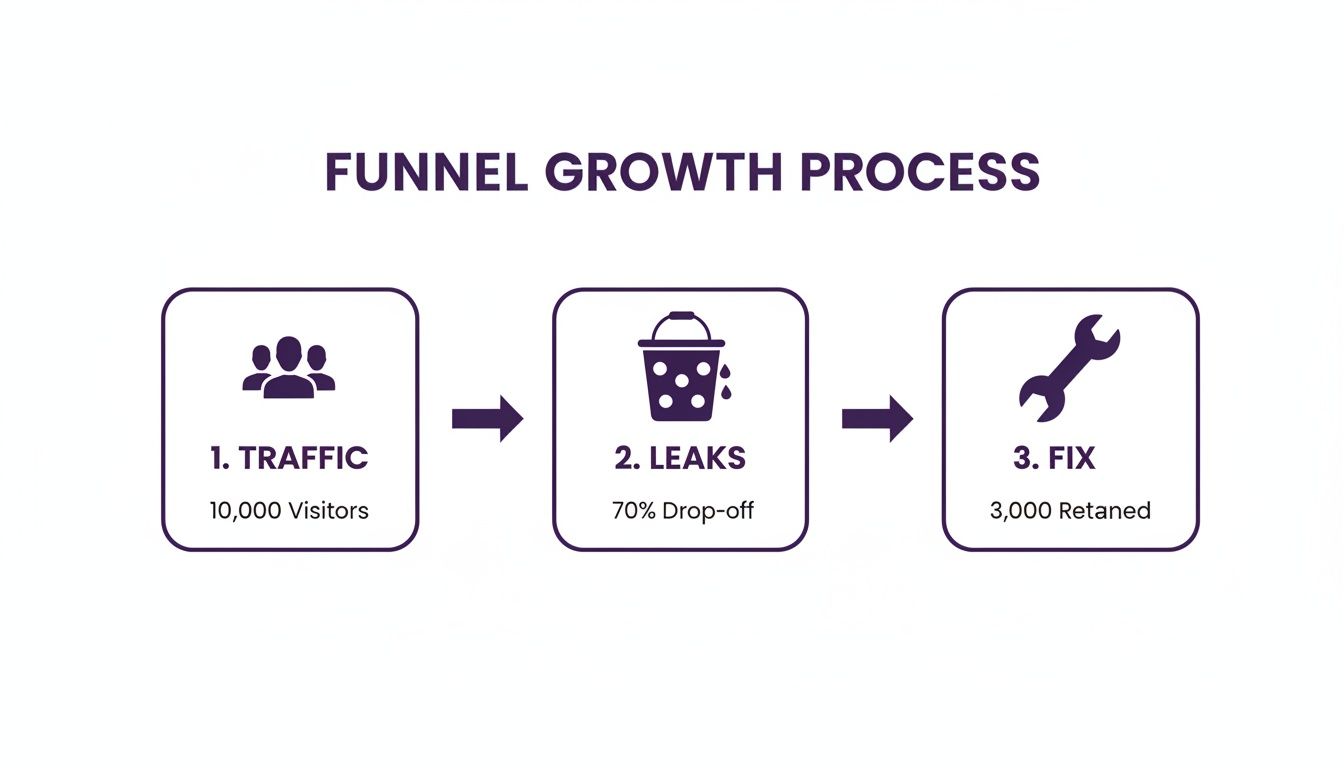
It’s amazing how a small, targeted fix can have a massive impact on how many customers complete their journey.
Start with a Heuristic UX Audit
A heuristic UX audit is like having a seasoned mechanic inspect an engine. It’s an expert-led review of your website against proven usability principles, and experts know exactly where to look for common faults. It’s a fast, effective way to spot the most common conversion killers without getting bogged down in complex data.
An audit will quickly flag issues like:
Confusing Navigation: Are people struggling to find essentials like your pricing or contact form? If they have to hunt for it, they’ll give up.
Weak Calls-to-Action (CTAs): Are your buttons vague or hidden? A button saying "Submit" is nowhere near as compelling as one that says "Get Your Free Quote Now".
Poor Mobile Experience: Does your booking form fall apart on a smartphone? With most web traffic coming from mobile, a clunky mobile experience is a direct leak in your revenue bucket.
This first pass gives you a high-level map of problem areas. To go deeper, learn how to find and fix the real conversion killers on your website in our dedicated guide.
Dive into Your Analytics Data
Your website analytics platform, like Google Analytics, is a goldmine for identifying leaks. The goal isn't to see how many people visit; it's to find out where they're leaving.
Look for high exit rates on critical pages. If a huge percentage of users are bailing from your SaaS pricing page, that's a massive red flag. Perhaps the value isn’t clear, or the pricing itself is confusing. For a tourism operator, a high drop-off rate on the final checkout page usually points to unexpected fees or a clunky payment process.
Don’t just look at overall traffic. Analyse the conversion funnels for your most important goals. A high abandonment rate between two specific steps is a clear signpost pointing directly to a user experience problem.
Visualise User Behaviour with Heatmaps and Recordings
Analytics tell you what is happening, but tools like heatmaps and session recordings tell you why. They provide a visual story of user behaviour, uncovering usability issues that raw data alone will never explain.
Click Maps: See what users actually click on. Are they clicking on elements that aren't links? That's a clear sign your design is creating false expectations.
Scroll Maps: Reveal how far down a page people scroll. If your main call-to-action is below the point where 75% of users have already left, it’s practically invisible.
Session Recordings: Watch anonymised videos of real user sessions. See where they hesitate, rage-click in frustration, or abandon a form. This is the closest you can get to sitting next to your user.
Imagine a professional services firm uses a heatmap and discovers no one clicks their "Case Studies" link. This insight—based on real behaviour, not assumptions—tells them the link is poorly positioned or the copy isn't compelling enough to earn a click. Uncovering these blockers is the foundation of any successful growth and strategy.
What’s Really Stopping Your Customers?
It’s easy to think of a “conversion blocker” as a big, technical website bug. But the truth is, most are small, almost invisible moments of friction that make a motivated customer pause, second-guess, and eventually leave.
What trips up a family trying to book a holiday is completely different from what makes a marketing manager abandon a software trial. To turn your strategy into real growth, you have to get specific about what’s going wrong for your customers, in your industry.
In Tourism: It’s All About Trust and Momentum
When someone books a trip, they’re excited but also anxious. They’re looking for reassurance they’re making the right choice. Any hiccup in the booking process shatters that confidence and sends them straight to a competitor.
Common booking funnel leaks include:
Surprise Fees at Checkout: This is the fastest way to destroy trust. A price of £300 suddenly becomes £350 after taxes and "service fees" are added. It feels deceptive, and they'll abandon the cart.
Clunky Booking Calendars: If a user can't easily see available dates and understand the price on their phone, they’re gone. A confusing calendar isn't a minor annoyance; it’s a dead end.
A Painful Mobile Checkout: Over 60% of travel is researched on mobile. If your checkout form requires pinching and zooming, with tiny fields and no support for Apple Pay or Google Pay, you are actively pushing customers away.
These aren't just minor flaws; they are significant barriers to revenue. As we've covered before, understanding why most tourism websites lose bookings in the first 8 seconds is the first step to plugging these expensive leaks.
In SaaS: The UX Is the Sales Pitch
For a Software-as-a-Service business, the user journey from homepage to paid subscription is your sales process. If there's a disconnect between your marketing promise and the reality of the trial, you’ll lose that user for good.
A complicated sign-up flow or an empty, confusing trial dashboard creates instant churn. The user came looking for a solution, and if they can't see immediate value, they have no reason to stick around.
Classic SaaS conversion killers to watch for:
Vague Value Propositions: Can a visitor land on your pricing page and understand in five seconds exactly what problem you solve and for whom? Generic headlines and feature lists without clear benefits fail to connect.
High-Friction Sign-Up Forms: Asking for a credit card to start a free trial is probably the single biggest conversion killer in SaaS. Close behind are long forms demanding a phone number and company size before they’ve even seen the product.
A Broken First-Run Experience: Your marketing promised they could "simplify accounting in 5 minutes." They sign up and... they’re dropped into a blank dashboard with zero guidance. This gap between expectation and reality is a churn-driver.
For Professional Services: It’s About Clarity and Access
If you’re a consultant or agency, your website has one primary job: build trust and make it easy for qualified leads to connect with you. You're selling expertise, so your website must reflect that with absolute clarity. The biggest mistake is making it hard for someone who wants to hire you to get in touch.
These roadblocks are all too common:
Jargon-Filled Service Descriptions: Potential clients don't understand "strategic growth enablement." They understand "we help B2B firms generate qualified sales leads." If they can't quickly see that you solve their specific problem, they'll assume you can't.
Hidden Contact Details: A prospect should never have to play detective to find your phone number or email. Hiding contact info sends a clear signal: "we don't really want to talk to you."
Interrogation-Style Contact Forms: Your first contact form is not the place for a 20-question deep dive into a prospect's budget and timeline. All you need is a name, email, and a message to begin the conversation. Anything more creates unnecessary friction.
Industry-Specific Leaks and Their Business Impact
Ultimately, identifying and removing these blockers is the most direct path to improving your key business metrics. It's not about redesigning your whole site; it's about finding and fixing the specific moments where good customers give up.
Building A Prioritised Roadmap For Growth
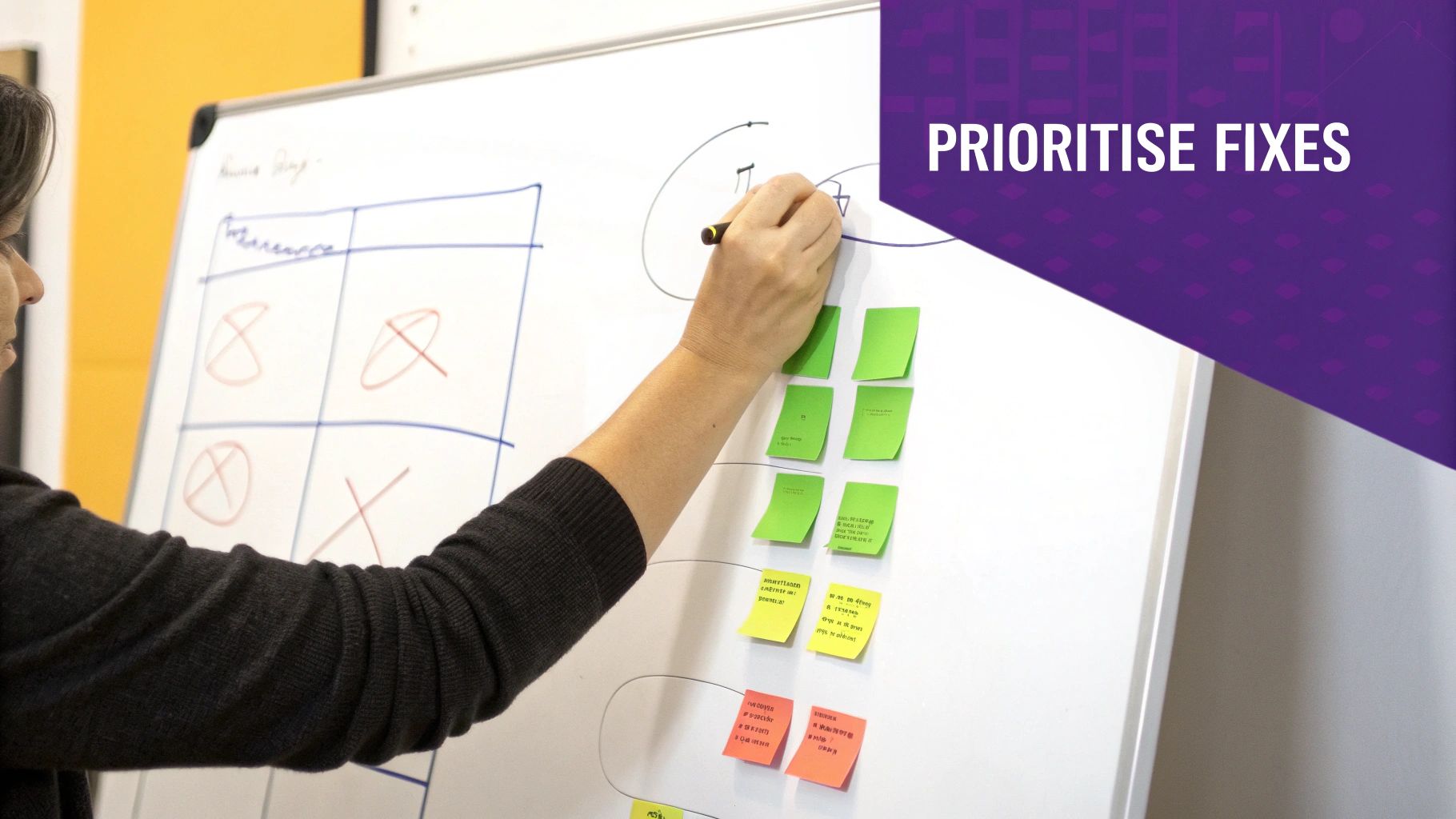
After you've diagnosed your website’s conversion leaks, you’ll probably have a long list of issues. This is where most businesses get stuck. Faced with dozens of potential fixes, teams often fall into analysis paralysis or, worse, just start tackling the easiest tasks first.
A long list of problems is not a plan. To create real commercial momentum, you need to shift from a random to-do list to a strategic, prioritised roadmap that focuses your resources on what truly matters for your growth and strategy. It’s about making deliberate choices that deliver the maximum return on effort.
Introducing The PIE Framework
A simple yet powerful way to bring order to the chaos is the PIE framework. It forces you to evaluate each potential fix against three clear commercial criteria: Potential, Importance, and Ease.
Score each item from 1 to 10 for each category, then average the scores to get a final priority number. It’s a straightforward system for turning a subjective list into an objective, data-informed plan.
Potential: How much improvement can we realistically expect if we fix this? Optimising a high-traffic page like your booking engine has far greater potential than tweaking a rarely visited blog post.
Importance: How valuable is the traffic going through this friction point? A confusing step in your paid trial sign-up flow is mission-critical (high importance), while a broken link on your 'About Us' page is less so.
Ease: How much time and resource will it take to implement this fix? A simple text change on a button is low-effort; redesigning your entire booking calendar is a high-effort project.
By scoring each issue this way, you create a prioritised backlog where the highest-scoring items are your most valuable opportunities.
From Reactive Fixes to Proactive Wins
Using a framework like PIE fundamentally changes your approach. It steers your growth and strategy away from random acts of optimisation and towards a deliberate programme of continuous improvement. Your immediate goal should always be to identify and execute the high-impact, low-effort changes first.
These "quick wins" are strategically vital. They deliver immediate, measurable improvements to your conversion rates—more bookings, better leads, or increased trial sign-ups. Securing these early results also builds crucial internal momentum and stakeholder buy-in for ongoing optimisation work.
The objective isn't just to fix things; it's to build a system for growth. A prioritised roadmap transforms your website from a static brochure into a dynamic asset that is constantly evolving to better serve your customers and your commercial goals.
This strategic approach is becoming more critical than ever. In New Zealand’s dynamic business environment, accelerating entrepreneurial activity highlights a key trend. With 744,728 registered companies as of September 2025 and 16,111 new incorporations in Q3 alone, the market is rewarding digitally savvy businesses that optimise every customer interaction. You can learn more about the latest NZ business formation statistics.
A prioritised roadmap is no longer a "nice-to-have"; it’s a competitive necessity. By moving from a disorganised list of issues to a structured plan, you create a clear, commercially-focused path that connects every UX improvement directly to the growth of your business.
Uncover Your Hidden Conversion Gaps Fast
Stop guessing where your website is losing money. Our UX Snapshot is a fast, expert-led analysis that identifies the most critical conversion leaks in your funnel. Get the actionable insights you need to improve your growth strategy today.
Ready to Stop Losing Customers?
An effective growth strategy doesn't start with throwing more money at marketing. It starts with a simple, powerful shift in focus: from chasing more traffic to getting more value from the visitors you already have. Pouring cash into ads while your website is leaking customers is one of the most expensive mistakes a business can make.
Fixing these conversion leaks is the fastest, most direct path to increasing revenue and building a more resilient, profitable business. This isn’t about guesswork. It’s a methodical process of finding the friction in your customer's journey and removing it.
So, Where Do You Start?
This is where most optimisation efforts fall over. You can't fix problems you can't see. Instead of guessing what’s wrong, you need a clear, expert-led diagnosis of your website's biggest conversion gaps.
That's exactly why we created the UX Snapshot.
This isn't a generic, automated report. It's a fast, focused analysis from a real conversion expert, designed to uncover the most critical issues costing you money right now. We'll show you precisely where your leaks are in a clear, actionable report and give you a prioritised plan to fix them.
Stop wasting your marketing spend on a website that doesn't convert. A real growth strategy is built on continuous improvement, starting with the assets you already own.
Don't let hidden friction dictate your growth potential. It's time to take the logical next step toward a smarter strategy.
Find Your Hidden Conversion Gaps—Fast
Stop guessing where your website is leaking money. Our UX Snapshot is a quick, expert-led analysis that pinpoints the most critical conversion blockers in your funnel. Get the actionable insights you need to improve your growth strategy today.

Subscribe to our newsletter
Stop losing bookings, get insider tips to turn your website into a conversion machine.
More posts
Insights to help you turn more visitors into bookings, through better SEO, UX, and conversion strategy.
Customer journey mapping for bookings and enquiries (practical guide)

Marketing for B2B: A Modern Playbook for High-Growth

How Strategy and Branding Drives Conversions for NZ Businesses